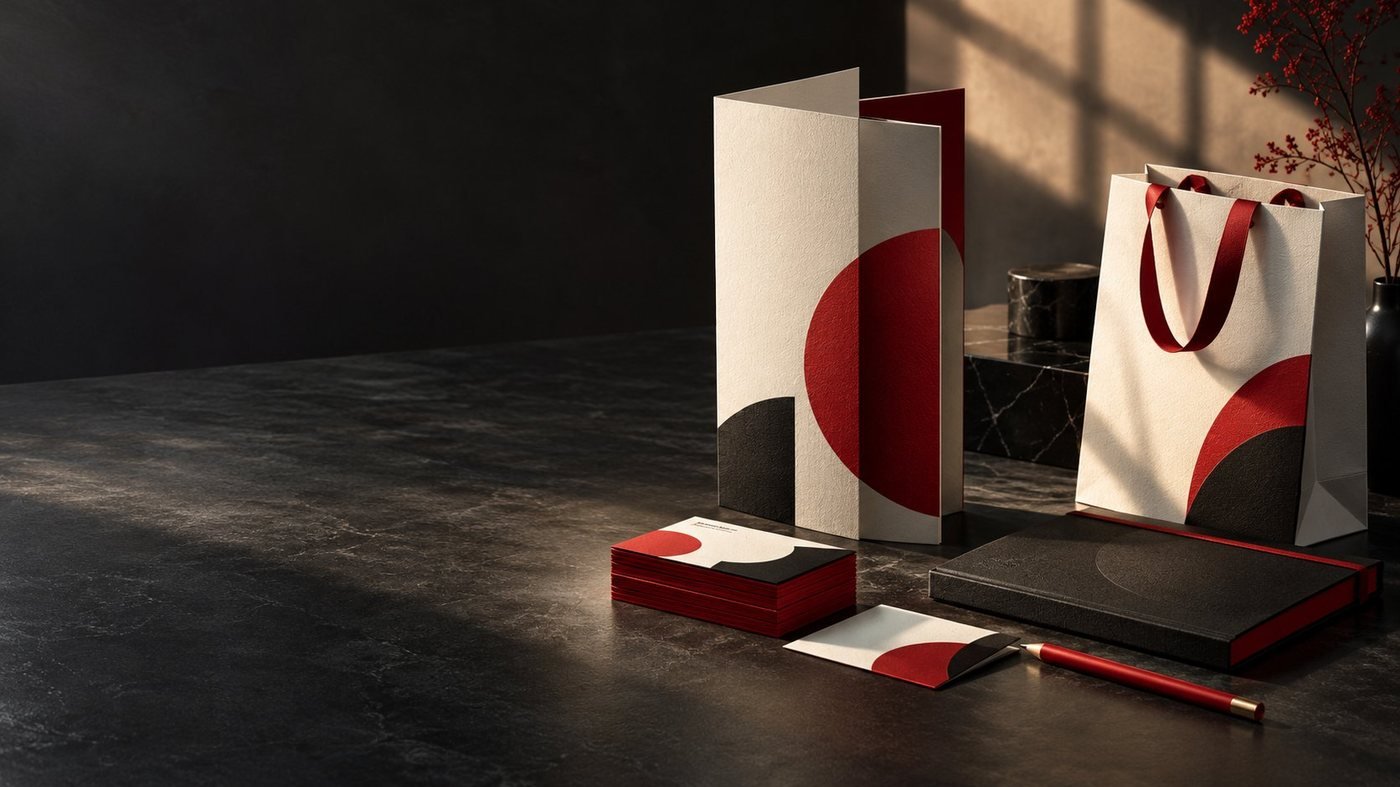
"We need some brochures — or maybe flyers?" It is one of the most common questions print customers ask, and the two are often confused. Both are printed sheets that promote your business, but they are built for different jobs. Choosing the right one saves money and gets your message read instead of recycled. Here is how they differ, and how to decide.
The basic difference
A flyer is a single flat sheet — usually A5 or A4 — printed on one or both sides. It carries one message: an opening, an offer, an event, a new menu. A brochure is folded (or multi-page), which gives it panels and a reading order. It carries a story: who you are, what you offer, why you, and how to buy. Think of the flyer as a headline and the brochure as the conversation that follows.
Side-by-side comparison
| Flyer | Brochure |
|---|
| Format | Single sheet, flat (A6, A5, A4 or DL) | Folded sheet (bi-fold, tri-fold) or multi-page booklet |
| Content volume | One offer or announcement; minimal text | Multiple sections: services, prices, company profile, testimonials |
| Lifespan | Short — tied to a date or promotion | Longer — kept for reference over months |
| Best distribution | Handouts, door-to-door, inserts, counters, events | Meetings, showrooms, exhibitions, mailings to prospects |
| Design effort | One strong visual and a clear call to action | Structured layout across panels with a reading flow |
| Cost drivers | Size, paper, quantity, single/double-sided | Size, folds or pages, paper, finishing, quantity |
Choose a flyer when…
- You are promoting one thing: a grand opening, a seasonal offer, a new branch, an event date.
- The message has an expiry date — after the promotion ends, the piece should be disposable.
- You need volume: large quantities for handouts at exhibitions, in-store distribution or neighbourhood drops around Dubai.
- Speed of reading matters — a flyer must communicate in about five seconds.
Explore formats and paper options on our flyer printing page.

Choose a brochure when…
- Your product or service needs explaining — property projects, clinic services, corporate profiles, equipment ranges.
- The piece will be kept and re-read: left with a prospect after a meeting, displayed in a showroom, or included in a proposal folder.
- You want to present several services or products in an organised way, each with its own panel or page.
- The audience is smaller but more valuable — quality matters more than quantity.
The most popular brochure format in Dubai is the A4 tri-fold (an A4 sheet folded into six panels, DL-sized when closed), followed by A4 or A5 booklets for catalogues and company profiles. See our brochure printing options and company profile printing for formats.
Paper and finish considerations
Flyers are commonly printed on lighter art paper (for example 130–170 gsm) because they are produced in volume and read once. Brochures that must feel substantial in a meeting often use heavier stock (170–300 gsm) with a matte or gloss lamination on the cover. These are general patterns, not rules — the right combination depends on your design, folding and quantity, and your printer will confirm what suits your artwork. One technical note: folded brochures need artwork set up panel-by-panel in the correct order, which is different from a flat flyer layout. If you are supplying your own file, ask for the fold template before you design.
Using both together
Many Dubai campaigns use the two as a pair: flyers distributed widely to generate enquiries, and brochures reserved for the people who respond — at the showroom, in meetings, or inside a presentation folder. The flyer creates the lead; the brochure closes the conversation. Keeping the design consistent across both (same colours, fonts and imagery) makes the small campaign feel like one professional brand — our guide to consistent branding explains how.
Sizes at a glance
For flyers, A5 (half of A4) is the Dubai workhorse — big enough for a strong image and an offer, small enough to hand out and slip into a shopping bag. A4 suits information-heavy handouts and takeaway menus; A6 and DL sizes work for compact invitations and inserts. For brochures, the A4 tri-fold leads, with A4 bi-fold (opening like a booklet to A3) popular when each spread should showcase one product or property, and A5 booklets common for compact catalogues. None of these is mandatory — sizes are cut to order — but standard sizes use paper efficiently, which keeps quantities economical, and they fit standard display racks and envelopes.
A simple decision rule
If the reader needs to act this week, print a flyer. If the reader needs to understand and remember you, print a brochure. If you are not sure, tell your printer the campaign goal — the format usually chooses itself.
Add either product to your Quote List from the pages above, or message us with your campaign details and we will recommend a format, size and quantity based on how you plan to distribute it.
Have a project in mind?
Tell us what you are planning — specifications, materials and artwork are confirmed with you before production, because every project is different.